Friday, September 15, 2023

Lough Neagh

We have become used to hearing the term anthropogenic climate change used to define the human activity which is leading to the progressively catastrophic changes in climate. There are other challenges quickly coming to the fore, with the realisation that many have already occurred, anthropogenic ecological and environmental collapse will define our future as much as climate change. Lough Neagh is showing every indication that, if it hasn’t already passed a tipping point, anthropogenic ecological collapse is imminent.

I grew up only a few hundred yards from Lough Neagh, regularly traversing Rea’s Wood from the area behind the Deerpark Hotel to the mouth of the Sixmilewater. Later, when an elected representative, I was a member of the Lough Neagh Partnership and I pay tribute to the work of the Partnership and especially Gerry Darby in trying to highlight the many issues facing the Lough and its environs.

It appears that the current situation has arisen due to a number of factors coalescing at the same time. Increased nutrient levels, particularly phosphates in the case of algal blooms, from human waste, farm effluent, soil run off and possibly disturbance of the nutrients captured in the Lough bed by sand dredging. The increased water temperature from climate change is directly related to human activity and the use of fossil fuels, a trend likely to continue for many years. The impact of zebra mussels in clarifying the water and allowing photosynthesis to occur at greater depth is also considered a factor in the current algal bloom. 

But these issues and the associated algal bloom are only symptoms of a wider decline which has been known about and disregarded for many years. In the 1970’s the increasing levels of chlorophyll-a (the measure of algal growth) in Lough Neagh led to a phosphate reduction programme at waste water treatment plants feeding into the Lough. This led to a reduction in chlorophyll-a in the 1980’s but by the early 1990’s the chlorophyll level started to increase steadily. I’ve asked about the levels of chlorophyll-a and phosphorous in the Lough since 2001 but it is clear that the wide agricultural catchment area is a factor in nutrient levels increasing during the 1990’s.

The eel fishery in Lough Neagh has produced around 500 tons of eels per year and is world renown. However, in the early 1980’s the number of glass eels (juvenile eels) returning from spawning in the Sargasso Sea dropped by 90%. The fishery collective began at that stage to buy millions of glass eels annually to restock the Lough. In terms of economic sustainability this has ensured that a level of economic activity has continued, in terms of ecological sustainability it is an entirely unsustainable method of addressing the long-term survivability of the ecosystem. This becomes more challenging with the threat to the chironomidae (Lough Neagh fly) population upon which eels and the various fish species feed. 

How much the arrival of zebra mussels has contributed to this requires detailed scientific assessment, as does the impact of pesticide use in the agri-food sector. In general, the number of insects in the UK has decreased by over 60% in the last 20 years. We hear lots about the loss of pollinators but the impact of insect loss in general has a devastating impact on the survival of many species. One thing is clear, the loss of chironomidae of the scale feared will cause an ecological collapse of fish species in the Lough Neagh system.

Over 40% of Northern Irelands land area drains into Lough Neagh, most of this land is agricultural sustaining a sector heavily dependent on grassland. Northern Ireland has 3% of the UK’s population, 6% of land area yet 17% of the UK’s total cattle herd. That means 17% of cattle waste is disposed of over a small area with even this supplemented by artificial fertilisers. In environmental terms much of this activity is unsustainable in its current format. While there are concerns about the demand for continued unlimited growth of the intensive agricultural sector the current moratorium due to concerns about inaccurate figures on pollutant levels represents an opportunity to engage with the sector about the significant changes in practice that must occur.

The challenges facing the lough are such that concepts of community ownership are incompatible with delivering the robust legislative framework to manage the changes needed. The same applies to private ownership or rights to extractive commercial activity. Only a public body, properly funded and with a legislative framework based on protecting the ecological and environmental foundations of the entire system can begin the generational process of undoing the damage caused.

Commercial fishing is no longer viable or sustainable and in the face of ecosystem collapse it must be ended. A buy out of existing licences for eels and coarse fish must be a priority action.

Sand extraction has been permitted without a robust environmental understanding of the impact on the entire ecosystem. Current proposals to extend extraction must be refused and a negotiated end to extraction within a short period of time must be implemented in line with the transfer of ownership of the lough bed to the public sector.

Changes in agricultural practices are vital in reducing nutrient leakage, whether this is the end of surface dressing with slurry on agricultural land or other more acceptable treatment becoming the norm with many farmers, a three-year programme of supporting farmers to purchase the equipment necessary before introducing a ban on the activity will assist in meeting environmental and climate change targets.

Across the United Kingdom under investment in waste water infrastructure has created an ongoing environmental crisis. Northern Ireland is fortunate that it does not have the financial asset stripping of the private sector in the rest of the UK to contend with, but lack of political responsibility locally to invest in infrastructure remains an issue. A robust independent assessment of NIW contribution to pollution levels and nutrient levels is required as a priority.

The number of overwintering birds at Lough Neagh have collapsed in the last few decades, wider ecological collapse puts the remaining populations at risk. There must be an end to recreational wildfowl shooting on Lough Neagh.

The current limitations on environmental protection caused by the departmental structures in Northern must be removed by the creation of a fully funded, legislatively powerful independent environmental protection agency outside the reach of potentially sectorally partisan government Ministers.

There is no doubt that various economic interests are already preparing campaigns to influence key politicians that whatever actions are taken should not interfere with their business. There can be no longer, in any field, an economic justification to continue taking actions leading to anthropogenic ecological and environmental collapse. Lough Neagh is no longer an economic opportunity based on asset stripping the resource.



Thursday, July 6, 2023

Meat

In his book Ravenous Henry Dimbleby points out "With or without UK companies on board, the protein transition is coming." (Ravenous 2023 pg226) On the 21st June 2023 CNN reported

"Cultivated meat, also known as lab-grown meat, has been cleared for sale in the United States.

Upside Foods and Good Meat, two companies that make what they call “cultivated chicken,” said Wednesday that they have gotten approval from the US Department of Agriculture to start producing their cell-based proteins." (https://edition.cnn.com/2023/06/21/business/cultivated-meat-us-approval/index.html)

In 2019 KFC announced a partnership with a company in Moscow to produce 3D chicken products from plant protein and cultivated chicken.

Finnebrogue a well known artisan food producer in Northern Ireland has announced a partnership with Ivy Farm Technologies to work together on laboratory grown Wagyu beef burgers.

The changes that will follow this new technology will be highly significant and will change the face of agriculture, particularly in areas like Northern Ireland where the growth of the chicken processing industry has seen massive investment and where the production of beef is such a fundamental part of the farming landscape.

Consider the production of the standard broiler chicken from egg to supermarket shelf. An entire industry exists to ensure the production of genetically suitable eggs before incubation and hatching. Transportation to farmers who have made significant investment in sheds capable of supporting 10's of thousands of chicks to finish point at around 6 weeks. Transported then to slaughter and butchering in processing factories. Much of the meat will be minced and used to create nuggets, goujons, Kyiv's and other processed products. 

The opportunity exists and is proactively being developed by the food processing industry to replace all of the activity in the previous paragraph between "Consider" and "factories" with a "lab grown" product. Large vats will produce chicken meat, grown from chicken cells, in vast quantities ready for processing and onward sale. Current breeding is based on quick growth rates, future product can be sourced based on taste or other preferred qualities.

Processors do not exist for the benefit of farmers, in a world where 2/3rds of all birds in the world are chickens the potential to save many of the costs of production will appeal to their economic models. They will welcome the opportunity to market their "real chicken" products as Environmentally friendly, Climate friendly, Chicken friendly healthy protein.

The outlook for beef will follow, imagine if McDonalds was to move to a similar model. There will still be beef from cattle, there will still be chicken from chicken's but the current model of production will have changed and such beef and chicken will come at a premium and the market will be much smaller.

Pretending that change won't happen isn't the answer, preparing for such changes will be fundamental to many peoples lives.


Monday, June 26, 2023

Crossroads


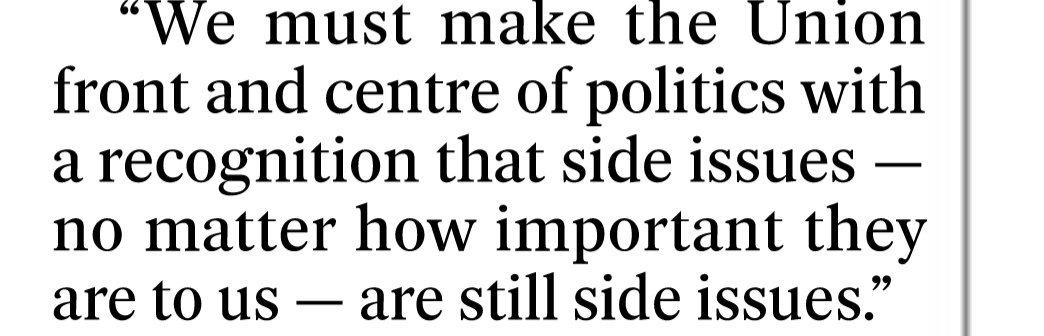
The statement above, made to the press by Tom Elliot MLA in the aftermath of the council elections, illustrates the dearth of understanding among some unionist politicians. His beliefs will be shared by most in the Democratic Unionist Party and Traditional Unionist Party and some in Ulster Unionism. No doubt were all unionist parties and Loyal Orders to gather to reflect on the way forward for unionism they would double down on the sentiment. An echo chamber magnifying the sentiment threatens to sideline and isolate unionism in the short-term and end the union much quicker than Republicans can ever dream of.
Thankfully there remain unionists who recognise the shear futility of that approach.  It is a betrayal of public office to side line the challenges which the general population face, it is also the complete antithesis of what being part of the United Kingdom should represent.
The idea that politicians should treat as "side issues" collapsing public services, poverty, deprivation, poor health, bad housing and all the other challenges we face now and in the future is not what holding elected office is about.
To suggest that concern about having enough food for your children, or getting through to a GP surgery, or heating your home is a "side issue" shows an amazing disconnect from the lives of the people unionism seeks to represent. That disconnect works both ways as the inability of political unionism to turn out their voters shows.
The Union will not be protected by setting aside the issues affecting our citizens, it will only survive by showing that those issues are best resolved within the Union. That requires a political change at the heart of unionism, an end to the dogma of opposition to any change, an end to the insular view held by many that ignores the world around them. Only by making Northern Ireland work within the Union can we counter the fantasy future presented by Republicans.
Thankfully there remains within Ulster Unionism a core belief in delivering a better society as the way to protect the Union. That belief must not be diluted by being drawn to short-term comfort under Paisley's umbrella, or sitting in Jeffrey's tent. The fight that needs to be fought is not simply about the flying of the flag but about the values the flag represents. In that those who don't put the needs of our people first will be on the opposing side, meeting the needs of our people is the best defence we have for the Union.
Ulster Unionism has come some way in articulating the concept of a "Union of people", in light of recent comments we should go further, what is needed is a "Union for people" deliver that and we deliver a better life and a better future for all.


The Union


The word union is a strange word, Google "union definition" and you get "the action of joining together or the fact of being joined together, especially in a political context". It's a noun and many people choose to interpret that as meaning it describes a defined state of existence that should be understood by everyone, no further action or interpretation is needed. Yet every union is subject to tensions and stresses especially where that union exists "in a political context".

As Brexit has shown the maintenance of a union requires continuous engagement and negotiation with all the parties to a voluntary union to ensure that the basis of the union still exists. For unionism in a UK sense this remains an important factor which ulster unionism (small "u") struggles to understand. While the determination on whether the people of Northern Ireland choose to remain within the UK is for them alone, the actions required to improve what the union has to offer its citizens is a matter for all its citizens.

A future referendum on Northern Ireland's position will offer 2 choices, to join with the rest of Ireland or maintain the Union. While it is clear that those advocating for a United Ireland will have made significant efforts to define the social, economic, cultural and political realities of that choice those advocating for a maintenance of the Union face multiple challenges.

There is a medical term called "cognitive dissonance", frequently described as "the mental discomfort that results from holding two conflicting beliefs, values, or attitudes. (https://www.verywellmind.com/what-is-cognitive-dissonance-2795012). Unionism struggles with a form of political cognitive dissonance, on the one hand ulster unionism demands equal citizenship with everyone else in the nation, on the other hand, once equal citizenship is given on a particular issue ulster unionism flies into almost apoplectic rage at the thought of being treated as equals. We have spent our political lives ignoring this rather large elephant in the room, come a border poll this elephant will be paraded through every issue being debated, ignoring it is not an option.

Of course, the narrowness of ulster unionist thoughts on the union subtly ignores the fact that ulster unionism represents about 1.5% of the UK population. It takes a particular arrogance to suggest that ulster unionism should be the section of society to define the union moving forward. Whatever the vision of the union of the future, the union that is presented as the alternative to a united Ireland, it is not for ulster unionism alone to define. Neither is it a vison to be determined by unionism joining with a few right-wing national actors seeking a new cause celebre to rally people to the flag.

Whatever the union of the future looks like it must reflect the aspirations of all its citizens, including, but not exclusively, ulster unionism. A national discussion, a conversation, must transcend party politics, it must include a space to listen not just to the powerful but the powerless. The union must be more than a flag, or loyalty to the Crown, it must define the rights of citizens, the responsibilities allocated to Governments and the benefits accruing to all.

Even without the possibility of a border poll it is an exercise worth having, not just for ulster unionism, for the UK as a whole. We, the UK, have drifted along, pushed and pulled by world events and our own choices, to arrive at a point where an honest conversation about who we are and what we want to achieve for future generations would help create the foundations upon which our future society will be built. For ulster unionism, making the case for such a conversation, not only helps define our future locally but strengthens the nation as a whole.


Monday, June 12, 2023

Unionist Unity will end the Union

By 2030 Northern Ireland will face an existential threat to its continued position in the United Kingdom, if by that stage the threat has not already been realised.  

A border poll is coming, based on demographics alone, the fact that it will come represents a total failure, so far, on the part of unionism to understand politics or the world around us.

We could have focused, and still can if committed to the challenges, on creating a society which improved the quality of life of all our citizens to the point where a "New Ireland" could not improve on what people's experiences were. We could have provided no incentive to those whose future constitutional outlook has yet to be decided to look southwards.

Instead the response from many in unionism is to find a bigger flag, no doubt pondering that when it is finally lowered to the sound of "Abide with me" their honour will have been satisfied. Those individuals demanding unionisms loyalty and unity to their political philosophy and "strength" in Westminster and Stormont will demand the same loyalty as they take their seats in the Dail.

It doesn't have to be the only option, the union can be salvaged, but a choice has to be made, the DUP's union of bigger flags and unionist fealty to the archaic, or a unionism committed to the future, modern unionism facing the challenges ahead, not shirking responsibility. 

Save the DUP or the Union, it can't be both.

Sunday, May 21, 2023

A few thoughts on #LE23

A few comments on the local government elections and the aftermath.


For unionism in general, a point on demographics, unionism only holds a majority in the oldest age group, as a way of factoring this into future trends consider that as those unionist numbers reduce over time each unionist elector is effectively replaced by 2 young people from a nationalist background. That demographic change will occur constantly and will impact every election to a greater or lesser degree, as will population shifts in local elections from changes such as significant housing developments, these should not be a surprise. A political movement that fails to understand the environment it operates in fails to understand the threats and opportunities that exist.


Sinn Fein's results indicate a turnout of their support in some areas well in excess of the average, again something that is out of the influence of unionist parties. What can be influenced is turnout of voters based on past delivery and future intentions, in a democracy everyone has an opportunity to improve that.


The results have allowed some to raise the possibility of unionism coming together into one party, a merger. Strangely only ever in the context of the UUP merging with the DUP, the TUV are never mentioned. Those who suggest such a move have taken little or no time to consider the issue, if they had they would understand how disastrous such a move would be for the future of the Union. For some, self preservation appears to be the main motivation and their voices are loudest.


The challenges facing Ulster Unionism are more structural than political though the undermining of the party through the Lundifying of Doug Beattie by other parties and an agent provocateur who appears to have an access all areas pass for local media was intense. That this was replicated by a small number inside the party, whether for personal gain or a genuine lack of understanding of the world we live in remains regrettable. I suspect the same individuals will promote a merger as their preferred future direction. 


Protection of political patronage in the face of declining numbers of voters attracted to the current offer from unionism under the DUP is a double betrayal, of past generations and future generations. A laziness which prefers to learn nothing and build nothing rather than create a society which more people will value and maintain.


The argument against the new Ireland mantra we face is not a red, white and blue citadel founded on archaic notions of society. It is the creation of a new Union which lays the foundations upon which future generations will build their society capable of facing the intense challenges to come. Only by focusing on delivering this can unionism hope to survive, anything else is collectively and individually selfish.


A closing point for unionism to consider, the Irish Government have established a Sovereign wealth fund with €13 billion surplus income this year. They intend to add €12 billion per annum, by 2030 it will have circa €100 billion. Imagine a Sinn Fein government in Dublin with a €100 billion campaign chest to form part of the New Ireland agenda presented as part of a border poll campaign. Can you imagine a UK government, Conservative or Labour, making the same offer for NI citizens to stay in the Union? Will Unionism understand the challenge- not if the DUP control all political thought.


Unionism focuses on the next election, republicanism focuses on the next generation. Unionism must do likewise and meet the needs of the next generation not the wants of the last generation.


Monday, March 20, 2023

Next Steps post Windsor


1 / 3
The last few years have proved difficult for unionism, some would have you believe the most difficult. Some would have you believe the threat to the union is existential and must be resisted in all its working to the nth degree.  
Nearly 40 years ago I heard the same rhetoric as I hear today, indeed from some of the same voices. Then I listened, I followed, I marched, rallied, plotted, planned and acted as my leaders required. In the end not one comma in the Anglo-Irish Agreement was changed. Yet, I am as British today as I was 40 years ago.
No doubt we shall hear a lot of rhetorical jingoism from some in reference to the “Stormont brake” and I am reminded of another speech made about Northern Ireland’s position in the UK. This time by the late Harold McCusker MP in the House of Commons in November 1985 after the signing of the Anglo-Irish Agreement. The full speech is worthy of note but specifically I recalled this section.
“I shall not argue with the Secretary of State about sovereignty because the House can change what it means by that. That came out in the debate yesterday. Sovereignty is what the Government decide it is.” Harold McCusker MP Hansard 28th Nov 1985
Thirty-eight years ago, Harold McCusker knew the truth about the United Kingdom, Parliament is sovereign, today some unionists still don’t understand or accept that reality.
For some in unionism action means inaction, boycott. A process that ultimately leads to more death, pain, discomfort, poverty, deprivation and lost life opportunities. It would be a brutal political strategy if the intention was to influence a Government committed to caring about the citizens affected by such a strategy. This Government doesn’t. Without a political outcome to such a brutal strategy the decision to continue it is an immoral one.
That doesn’t mean that unionism should accept the Windsor Framework or believe the spin promoted by the Government. This is modern Britain under the Conservatives, we live in Orwell’s world  
“Not merely the validity of experience, but the very existence of external reality was tacitly denied by their philosophy. The heresy of heresies was common sense.” Orwell 1984
Brexit was a disaster for the UK, warnings about the impact on the union were ignored and those who raised concerns about the economic consequences were pointed to slogans on the side of a bus. The Protocol was a failed negotiation by a UK team who did not understand the complexities they were meant to address and a unionist leadership in the DUP happy to devolve the issue to the Conservatives. Their initial support for Boris and the Protocol allowed the ink to dry before they were alerted to the dangers.  
The EU had one objective in dealing with Brexit, the protection of the single market, it was a concept the UK didn’t fully understand nor make any effort to understand, especially the consequences for NI, speed was the motivation for every UK decision. The offer of dual access to markets, while offering some opportunities also brings some risks, but the starting point is that the UK has signed a binding international trade agreement, walking away is not an option. Indeed it is likely that surreptitiously the Government will move closer to the regulations prevailing within the Single Market, business is already doing so. A future Government will move even closer, not out of any politically pro-EU motivation but due to the practical necessity of providing access to the large market on the UK’s doorstep.  The Windsor Framework is simply a step along that road, little to do with addressing the concerns of unionists.

2 / 3
In that context I believe that Unionism should not indicate support for the Windsor Framework, as such support is a meaningless action for something we have had no input into nor decision making authority for.  It provides a fig leaf of respectability for a Government that deserves no such cover. The results of the Frameworks outworking will be complex and challenging, the interrogation of rules and regulations, deep negotiations and a level of understanding on impacts hitherto not a feature of local politics for any party. Rejection may be the choice of some, especially the DUP, but again it’s a meaningless fig leaf, unionists either acknowledge the sovereignty of Parliament or they don’t.  
So, what do I think unionism’s position should be, first, further infliction of morally questionable boycott tactics should end. This Conservative party is not swayed by increasing death rates, years of pain and suffering by our citizens, defunding of our schools, collapse of infrastructure or lost life opportunities for our citizens.  
Secondly, applying a simple principle, both in Brussels and Westminster, “nothing about us without us” the earliest engagement with Northern Ireland over proposed changes to anything which affects us under the Windsor Framework. Rather than trying to dissect the intentions of changes after the fact include representatives from NI in the initial engagement. This will be challenging for unionism as engagement won’t be on a veto basis, (Sunak hasn’t delivered a veto no matter the spin), being better politicians is the key to using the system to NI’s advantage.
Thirdly, the action of unionist leaders to challenge the Protocol through the courts highlights the challenges the UK has without a formal written constitution. Basing the challenge on Article 6 of the Act of Union highlights the significant changes already existing due to devolution, notwithstanding that in respect of trade the Act of Union predates railways and East – West trade was limited to what was carried on sailing vessels and by horse and cart.
“That all Parts of the United Kingdom, for ever, from and after the Union, shall have the same Allowances, Encouragements, and Draw-backs, and be under the same Prohibitions, Restrictions, and Regulations of Trade, and liable to the same Customs and Duties, and Import and Export.” Article 6 Act of Union 1800
The Government apparently is offering to amend the Northern Ireland Act to reassure unionism, I could not accept any reassurance from this Government, what can be amended once can be amended again, my identity is not in the gift of Conservatives. I believe that unionism can however make a significant request for the betterment of the UK as a whole. A request for the establishment of a constitutional convention, to provide within 5 years a written constitution to be accepted or rejected by referendum. A constitution which details the rights of citizens, the responsibilities of Parliament and the limitations of Government.
Finally, what of our relationship with the Conservatives. In the run up to the 2010 election I spent a year working with the Conservatives on the UCUNF project (named before I was involved). At that time there was a belief in the development of a centre-right socially aware conservatism, that iteration of conservatism no longer exists. Instead the Conservatives, controlled by the ideology and authors of Britannia Unchained, represented by the faux working class of Gullis and Anderson, the faux aristocracy of Rees-Mogg and the buffoonery of Boris have stepped far outside the tram lines of a caring society.  
There will be those who believe that unionism should stand with them still, the DUP have many who share this view, happy to stand in the shadows behind the Tories believing they too are in the limelight. In the coming weeks there will be those who articulate the need for unionism to stand united with conservatism with banners and flags flying. This is a venture the Ulster Unionist Party has no need to

3 / 3
be involved with. There may still be honourable Tories, I can name a few, but too few and Conservatism today has nothing to offer society. Individuals may be enticed by baubles, a bended knee at the Palace, a rare chance of the ermine. True belief in creating a better society cannot be set aside or bought off by mere trinkets or titles. As for working closely with the DUP, the difference between us is the difference between those who passionately believe in creating a better society and those who will sacrifice lives, inflict poor health, justify poverty and limit the life chances of our citizens in the pursuit of power. Those beliefs go in different directions, at no point do they cross.


A loss of trust

Prior to the announcement of the budget the Labour Government spent several weeks trying to clearly define what it meant when it used the te...